





ALL POSTS
ALL POSTS
Report: State of Specialty Espresso Quality in Ljubljana and Maribor, November – December 2025



5 min read
Last edit: Dec 29, 2025
After a pause, we return with the results of recent espresso sampling. Same as before, this report presents an objective overview of espresso quality in selected specialty cafés in Ljubljana and Maribor, based on measured brewing parameters and extraction performance.
The aim is to document current brewing practices, evaluate alignment with widely accepted specialty espresso standards, and identify observable trends across major Slovene cities.
The report focuses on measurable variables — brew ratio, Total Dissolved Solids (TDS), Extraction Beverage Fraction (EBF), and Extraction Yield (EY) — which together provide insight into strength, efficiency, and consistency in espresso preparation.
Methodology
Espressos were ordered and measured as served to customers.
Beverages were stirred, cooled, filtered, and measured using a refractometer. Extraction Yield values were calculated using a standard industry formula based on beverage weight, dose, and measured TDS.
To learn more about methodology, visit our first report.
Standard specialty espresso reference ranges:
- TDS: 8–12%
- Extraction Yield: 18–22%
- EBF: typically 40–55% but may vary depending on espresso style
Results are interpreted in context — lower or higher values may still produce enjoyable cups but can indicate stylistic or technical tendencies.
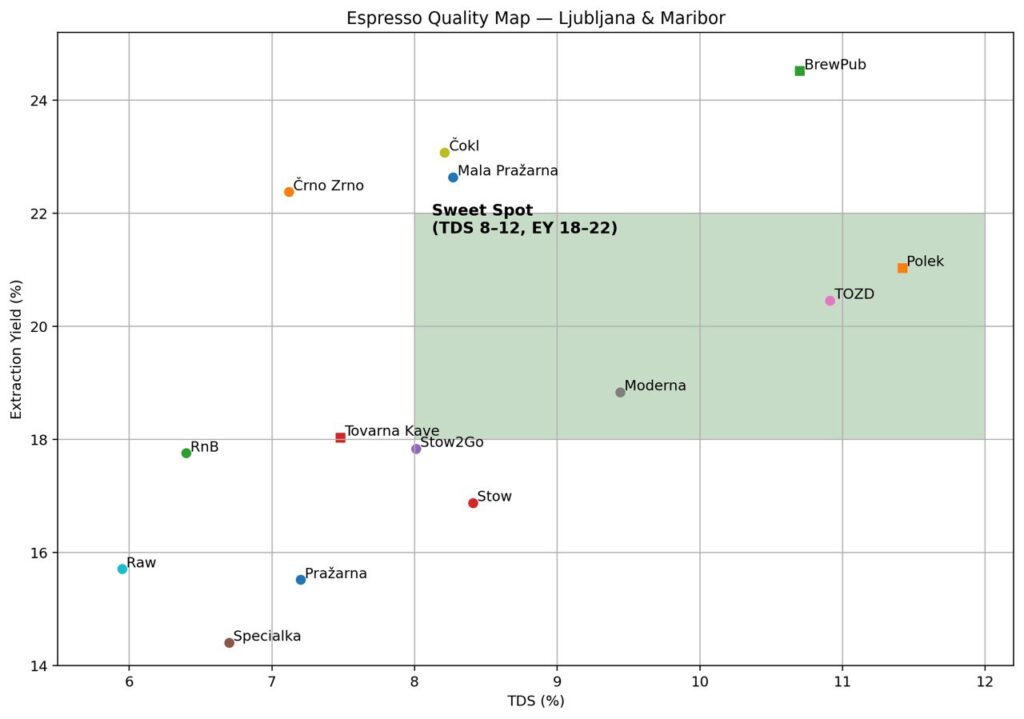
Sweet Spot is the highlighted sector in the Map table.
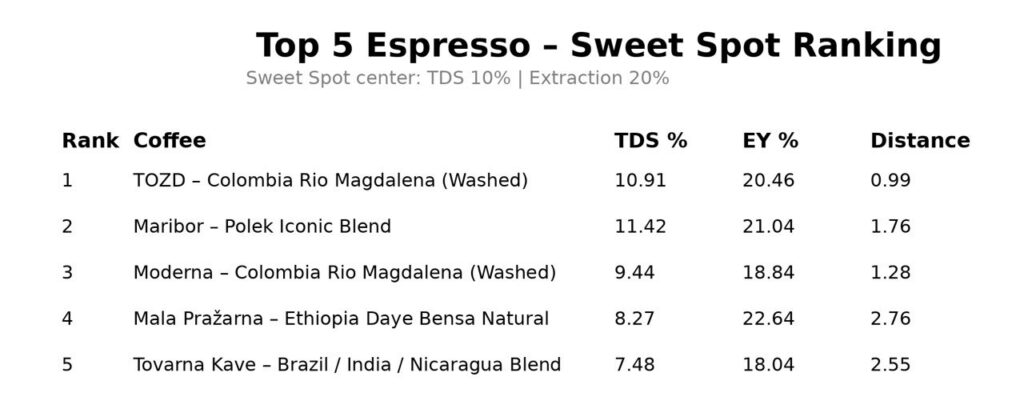
Sample list and details
Ljubljana
1. Mala Pražarna – Ethiopia Daye Bensa Natural
- In: 16.8 g | Out: 46 g | Time: 15s
- EBF: 36.5% | TDS: 8.27% | EY: 22.64%
A very fast extraction paired with an elongated ratio produced a high extraction yield despite moderate TDS. This suggests efficient solubility, likely aided by roast development and grind size choice. The short contact time, however, risks uneven extraction and a disbalanced flavor profile.
2. Črno Zrno – Colombia El Silencio “Jamaica” natural co-fermented Caturra
- In: 16 g | Out: 50 g | Time: 36 s
- EBF: 32% | TDS: 7.12% | EY: 22.38%
The extraction yield is high, but the strength is on the lower edge, which may be perceived as a lighter-bodied cup.
3. RnB
Brazil Espírito Santo Pinhal Natural Bourbon
- In: 19.1 g | Out: 53 g | Time: 27 s
- EBF: 36% | TDS: 6.4% | EY: 17.76%
This shot sits slightly below specialty strength and extraction targets. The data points toward under-extraction, possibly due to grind size or flow rate.
4. Stow
Costa Rica Esmeralda Caturra, Catuai
- In: 18 g | Out: 36 g
- EBF: 50% | TDS: 8.41% | EY: 16.88%
A classic 1:2 ratio with solid strength, but the extraction yield remains low. This suggests short extraction time or limited solubility, resulting in a punchy but potentially sharp profile. Most likely caused by critical channeling.
5. Stow2Go
Brazil Bom Jesus Natural Mundo Novo, Catuaí
- In: 18 g | Out: 38 g | Time: 25 s
- EBF: 47% | TDS: 8.01% | EY: 17.84%
Well-balanced strength with slightly low extraction. The slight underextraction is most likely caused by mild channeling.
6. Specialka
Brazil Caramelo Natural Caturra, Catuaí, Bourbon
- In: 20 g | Out: 43 g | Time: 22 s
- EBF: 46.5% | TDS: 6.7% | EY: 14.41%
Both TDS and extraction yield are significantly below target. This espresso is technically under-extracted, likely tasting thin and short, despite a modern ratio.
7. TOZD
Colombia Rio Magdalena Washed Castillo, Colombia, Caturra
- In: 16 g | Out: 30 g
- EBF: 53% | TDS: 10.91% | EY: 20.46%
A very concentrated espresso with high strength and solid extraction yield. This sits firmly in traditional espresso territory, delivering intensity and body.
8. Moderna Colombia Rio Magdalena Washed Castillo, Colombia, Caturra
- In: 19 g | Out: 38 g | Time: 28 s
- EBF: 50% | TDS: 9.44% | EY: 18.84%
A technically strong and balanced shot, comfortably within specialty ranges. Good alignment between strength and extraction suggests solid dial-in and consistency.
9. Čokl Brazil / Nicaragua Blend
- In: 17.8 g | Out: 50 g
- EBF: 35.6% | TDS: 8.21% | EY: 23.08%
High extraction yield with relatively low EBF indicates a long, slightly diluted style of espresso. While efficient, it risks dryness or hollow aftertaste flavors.
10. Raw
Colombia Las Perlitas Washed Chiroso
- In: 17.8 g | Out: 47 g | Time: 25.3 s
- EBF: 37.8% | TDS: 5.95% | EY: 15.71%
Very low strength and extraction suggest clear under-extraction, which may mute acidity and complexity in a coffee known for aromatic clarity and result in watery and hollow flavor.
11. Pražarna Brazil Colectivo Natural Caturra, Catuaí, Bourbon
- In: 18 g | Out: 38 g | Time: 25 s
- EBF: 47% | TDS: 7.2% | EY: 15.52%
Balanced ratio but low extraction yield. The cup will be perceived as mild and empty.
Maribor
1. Polek Iconic Blend
- In: 19 g | Out: 35 g | Time: 32 s
- EBF: 54% | TDS: 11.42% | EY: 21.04%
High strength and solid extraction place this espresso at the upper end of specialty intensity. A bold, dense profile likely appeals to traditional espresso drinkers.
2. BrewPub El Salvador / Ethiopia Blend
- In: 18.5 g | Out: 42 g
- EBF: 44% | TDS: 10.7% | EY: 24.52%
The exceptionally high extraction yield, combined with high TDS, suggests very efficient solubility. While impressive technically, this will be perceived as bitter due to over-extraction.
3. Tovarna Kave Brazil / India / Nicaragua Blend
- In: 17 g | Out: 41 g | Time: 15 s
- EBF: 41.4% | TDS: 7.48% | EY: 18.04%
A fast extraction produces an acceptable yield but lower strength. This reflects a lighter, more modern approach, though potentially lacking complexity.
Overall Observations & Trends
Ljubljana shows wide stylistic diversity, but many cafés fall below ideal extraction yield, indicating conservative dialing or low solubility approaches.
Maribor demonstrates generally higher TDS and extraction yields, leaning toward bolder, more traditional espresso profiles.
Several cafés achieve good strength but miss extraction targets, suggesting opportunities for improved grind distribution, shot time control, or recipe adjustment.
Why Regular TDS Measurements Matter for Café Economics
Beyond cup quality, routine TDS and extraction measurements offer direct financial benefits for cafés:
Consistency = Loyalty: Customers notice when espresso tastes different from visit to visit. TDS testing reduces variability, improving repeatability of the flavor profile and therefore of the customer’s experience.
Waste Reduction: Dialing in shots with precise data reduces wasted beans from guesswork adjustments.
Optimized Brewing Ratios: Understanding extraction efficiency allows cafés to fine-tune doses and yields, stretching each kilo of coffee further without sacrificing flavor.
Staff Training: Baristas can be trained on objective benchmarks rather than subjective taste alone, speeding up onboarding and improving reliability, as well as building sensory skills for further troubleshooting.
In sum, small investments in measurement tools pay off through improved quality, consistency, and cost-efficiency.
At specialtykava.si, we offer quality control and consulting services, including extraction control and support.
Conclusion
This snapshot reveals a specialty scene that is technically engaged but stylistically divided. While some cafés consistently hit balanced specialty ranges, others prioritize speed, mildness, or intensity at the expense of extraction efficiency.
Improving consistency to an 18–22% extraction yield while maintaining adequate TDS would enhance clarity, sweetness, and repeatability across both cities, benefiting both customer experience and café economics.
Would you like to learn more about other coffee roasters in Slovenia? Here are the guides.